தமிழ் பிராமி Tamil Brahmi
தமிழின் முதல் எழுத்து வடிவம் Tamil's first writing system
CICT Photographic Survey of Tamil-Brāhmī Stone Inscriptions (2007 – 2010) : A ReportM. V. Bhaskar, Project Co-ordinator |
|||
IntroductionWith a view to overcoming the limitations of traditional forms of documentation and towards constructing a comprehensive pictorial archive for posterity, the Central Institute of Classical Tamil (CICT) made available a grant to the Centre for Plants, People and Ecosystems (CPPE), a Chennai-based not-for-profit Trust. As a Fellow of CPPE, I took on the role of Project Coordinator, working with a team of specialists in digital imaging and content styling and transformation (See full credits at the end of this Section). Iravatham Mahadevan, the author of Early Tamil Epigraphy 2003, Harvard / Cre-A:, is the Honorary Consultant to the project. 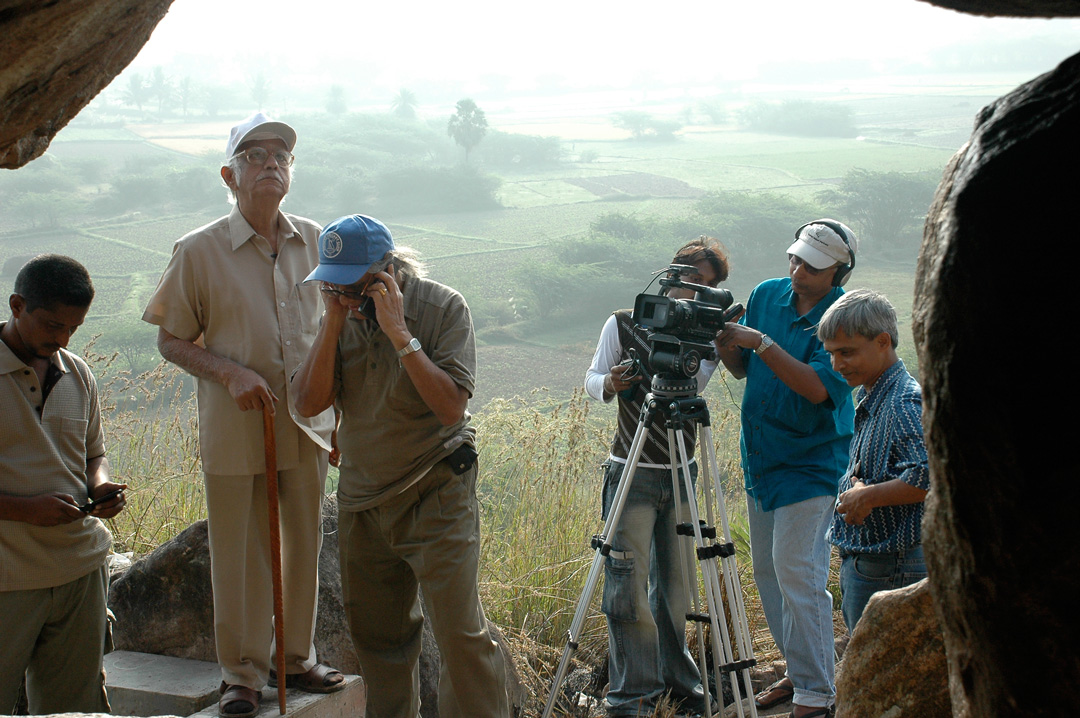 Fig. 1. L to R : Gandhirajan, Iravatham Mahadevan, Narasiah, Sarangarajan and Bhaskar. Inauguration of CICT Photographic Survey, Mamandur, December, 2007. Field WorkThe field work began with in situ documentation of the Tamil-Brāhmī inscription at Mamandur in December 2007 (Fig. 1) and closed with the documentation of the Vaṭṭeḻuttu inscriptions at Pulankurichi in January 2010 (Fig. 2 & 3), or so we thought. Subsequent discoveries drew the crew to Kilkuyilkudi (Samanarmalai) and most recently, in December 2012, to Edakal. All the 32 known caves in Tamilnadu and the lone cave in Kerala (Edakal) with Tamil-Brāhmī inscriptions, the 4 herostones from Pulimankombai and Thathappatti, as well as the Early Vaṭṭeḻuttu inscriptions (up to ca. 6th century C.E.) from Tamilnadu and Kerala were recorded by the project on HD Video and high resolution still imagery. For reasons of continuity, the project also documented, in February 2011, what is arguably the earliest, wholly surviving inscription in the Tamil script, at Chiruvakkam, near Kanchipuram. 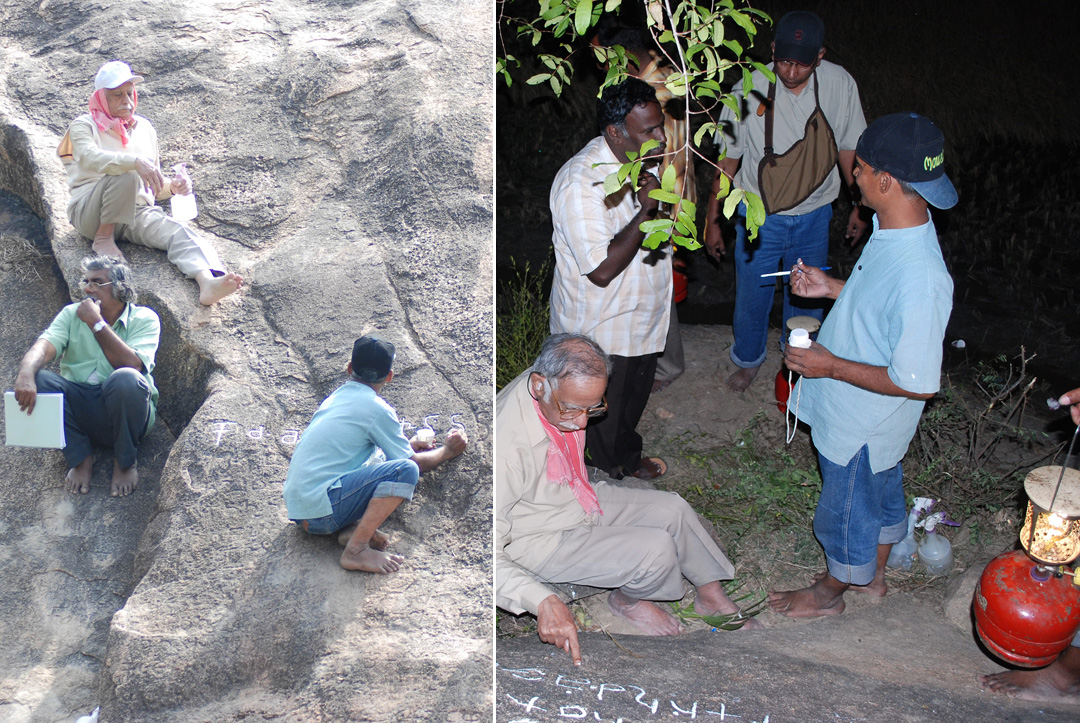 Fig. 2. Iravatham Mahadevan with Rajagopal (left) and Seetharaman (right), supervising the white-tracing of the inscription at Pulankurichi. January, 2010. 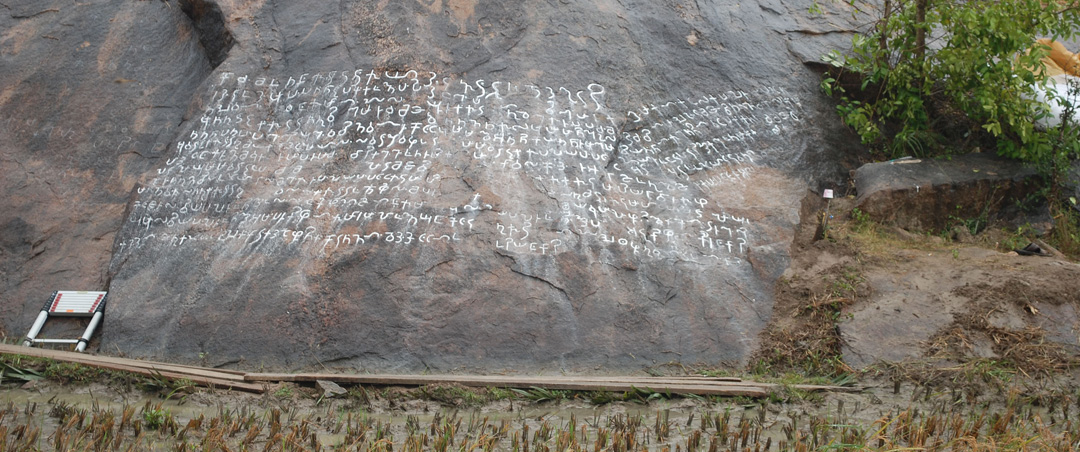 Fig. 3. The trace-painting gets washed away by rain at Pulankurichi. January, 2010. We had to abandon our first attempt, revisit the site, repaint, shoot and then wash the rock all over again. DocumentationDocumentation has been the main focus of the project. The addition of new knowledge, if any, has been incidental and scrupulously recorded on a case-by-case basis by Iravatham Mahadevan in the revised, expanded edition of Early Tamil Epigraphy 2013. The project can be regarded as an independent visual verification in situ of more than a century of early Tamil epigraphic documentation, especially of the tracings done by Iravatham Mahadevan and his team during their earlier expeditions, fully documented in his book, Early Tamil Epigraphy 2003. In the CICT Tamil-Brāhmī photographic archive, contextual documentation supplements every epigraphic record gathered from the field, in the sense that other lithic records from periods contemporary with Tamil-Brāhmī, and before and after Tamil-Brāhmī, in each location, have also been digitised and presented in historical and semantic association with the Tamil-Brāhmī records. This is the singular difference between the present effort and the methods of earlier documentation. Whether it be estampages, tracings or direct photographs, the earlier forms of documentation focussed on the epigraphs in isolation from the sources, whereas the CICT Photographic Survey has aimed to highlight the visual record of epigraphy without isolating it from the rich layers of information that the inscriptions are embedded in. These layers of information will be placed in the public domain, independent of this book, by the Central Institute of Classical Tamil. The objective and the result are illustrated in Fig. 4A - D. The inscription on the bare rock (A), Line 1 in Mangulam - 3, can be read in situ, but not from the photograph. The estampage (B) is virtually illegible and has led to incorrect readings by the earliest investigators and repeated by the later scholars who did not visit the caves themselves to verify the reading in situ. The tracing (C) by Iravatham Mahadevan's team makes the inscription legible, but isolates it from the background. The CICT trace-painting (D) avoids both the problems and produces a result which can be printed in a book. A high-resolution photographic archive is available at CICT for further verification with appropriate magnification. 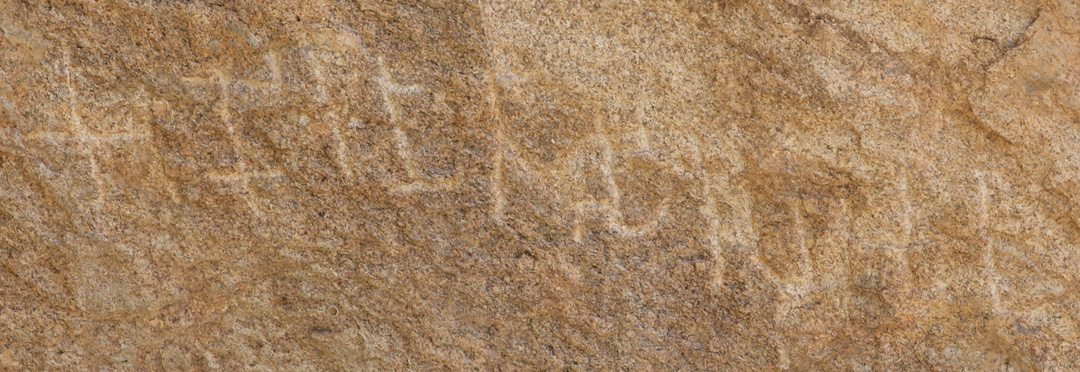 Fig. 4A. The bare rock hardly reveals the inscription. 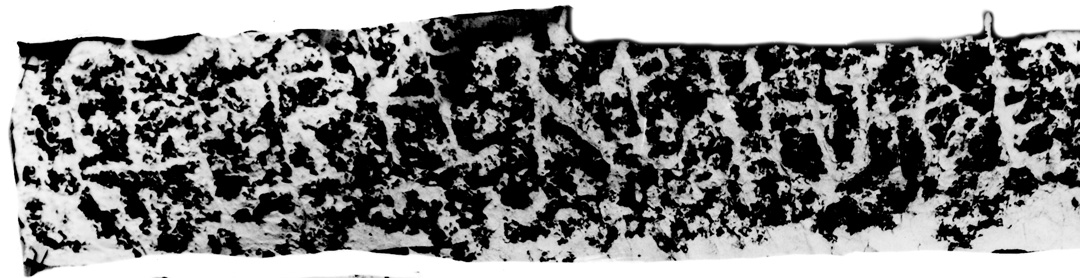 Fig. 4B. The estampage is difficult to make out and has led to incorrect readings. 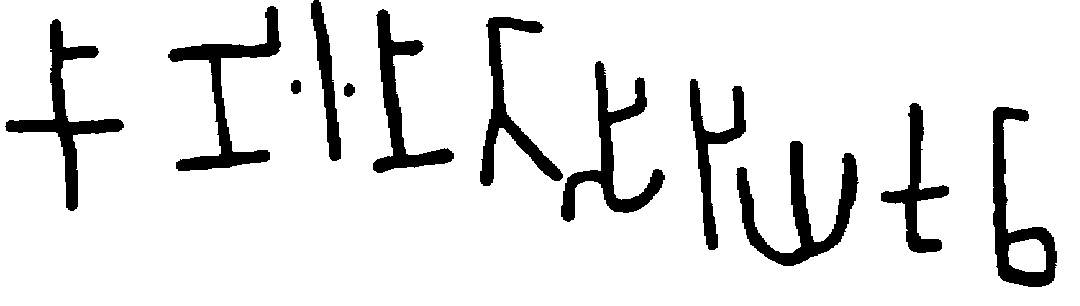 Fig. 4C. The black & white tracing (2003) is legible but isolates the inscription from its background. 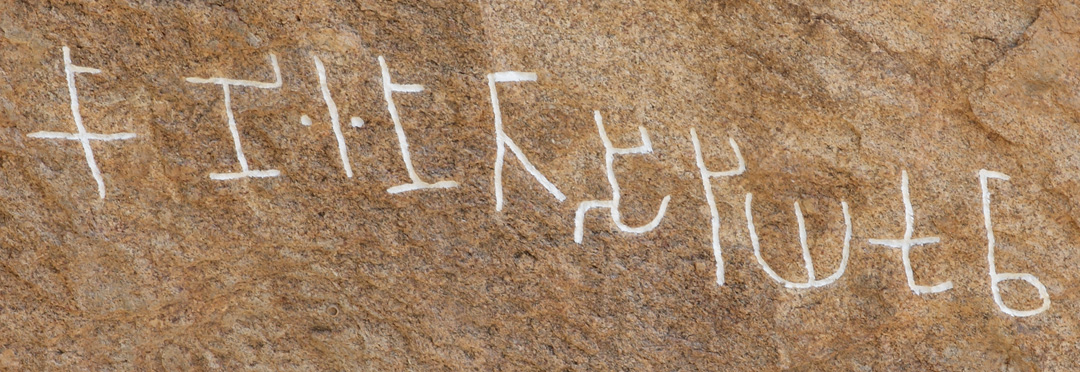 Fig. 4D.The trace-painting (CICT Survey) highlights the inscription accurately while preserving the background information also. Documentation Techniques, a RevisitEstampages antedate photography and have been a reliable method of epigraphic documentation from the 19th century. However, they are a specialist’s medium, difficult to share and communicate with those outside the field. In the context of Tamil-Brāhmī documentation, estampages have additional limitations. Tamil-Brāhmī epigraphs are inscribed on natural rock, often on curved, undulating surfaces. Estampages do not take into account these curvatures and flatten everything out. For these reasons, in situ tracing was preferred by Iravatham Mahadevan, which also flattens the curvature, but the result is at least clear and shareable. The single drawback of the tracing is that it isolates the inscription from its natural background. Both these forms of documentation are better suited to record inscriptions engraved on flat surfaces such as temple walls. Epigraphists have also used high-contrast, black & white photography to study Tamil-Brāhmī, but the photography in general lacked technical depth and the planning and imagination necessary to capture on camera a challenging subject like Tamil-Brāhmī stone inscriptions. CICT Photographic SurveyDigital imaging technologies have advanced rather rapidly in the past decade and a half and offer themselves as a serious contender for Tamil-Brāhmī documentation. In the formative stages of the Central Institute of Classical Tamil, which was then known as the Centre for Excellence in Classical Tamil attached to the Central Institute of Indian Languages (CIIL), Mysore, Iravatham Mahadevan had expressed to the then Director of CIIL, Prof. Udaya Narayan Singh and Prof. K. Ramasamy, Deputy Director then at CIIL, that the Tamil-Brāhmī inscriptions should be quickly documented with the best available technology. This suggestion formed the basis for the genesis of the CICT Photographic Survey. I had my first meeting with CIIL in March 2007 and in October the same year the project was assigned to the Centre for Plants, People and Ecosystems, with me as Project Co-ordinator. Prof. K. Ramasamy had many meetings with me in between which made this project a reality. At that time the revised edition that you hold in your hands was not part of the scheme of things, but once Iravatham Mahadevan saw the results of the Survey, he was enthused to revise the First Edition (2003) and replace the earlier tracings published in the First Edition with the fresh documentation produced by the Survey. That he chose to do so is significant. At the beginning of the Project, it was expected that Iravatham Mahadevan would be personally available to supervise the documentation. However, his health did not permit travel after the first location visit to Mamandur in December 2007 (Fig. 1). He made an exception to travel to Pulankurichi in January 2010 (Fig. 2). In between, the documentation was carried out largely guided in the field by the First Edition (2003) of Early Tamil Epigraphy. Nuances in DocumentationTamil-Brāhmī stone inscriptions occur on surfaces of varied hues, tones and textures. Some inscriptions are as long as 6 metres, while there are inscriptions that have just 3 letters. They occur amid fissures, in the interior of the caves and the exterior. They frequently occur on the brow of the cave, mostly below the dripledge, amidst chisel marks left after carving the dripledge. The inscriptions are almost always surrounded and criss-crossed by graffiti left by vandals. In fact, when you study Tamil-Brāhmī, you also simultaneously study the history of over two thousand years of the vandalism of of our cultural heritage. The camera cannot make sense of all the chaos that surrounds and subsumes the inscriptions. Even the well-trained eye cannot often make sense of this. Graffiti and fissures are always misguiding you into reading a ka as ke or pe. Frequently you imagine letters or signs that do not even exist. We call them a-birami ! Very often, you have to run your finger over the surface of the supposed letter many times over to realise that the letter is indeed there. The very first time I met Iravatham Mahadevan in March 2007, he asked me, raising his palm to my eye, Can you tell me why this finger (index) is shorter than this (middle) finger? I remember managing a blank smile for an answer and he said, without waiting for response, That's how much this finger has been run on rough granite to sense the letters! 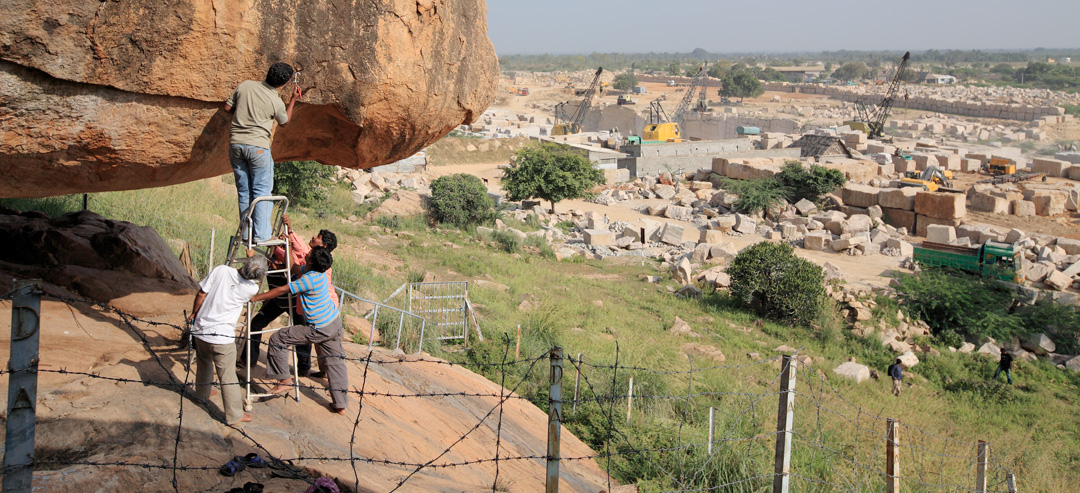 Fig. 5. Trace-painting at Tiruvadavur. This and Kilavalavu are the sites most affected by granite quarrying. These caves tremble to quarry bombs. You could say there is no site that is not affected by quarrying. 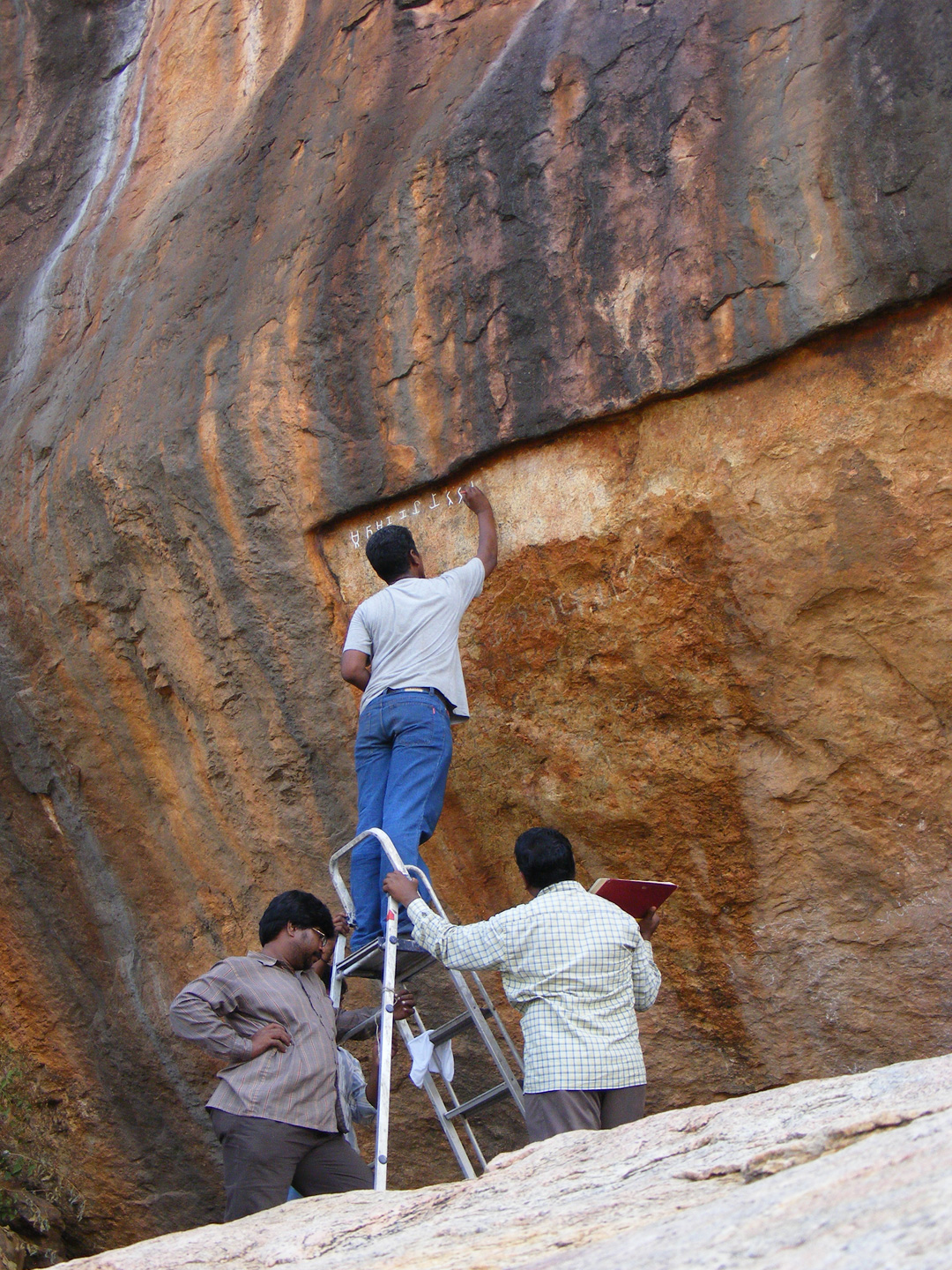 Fig. 6. Gandhirajan trace-paints the Pugalur 'Irumporai' inscriptions. March, 2009. 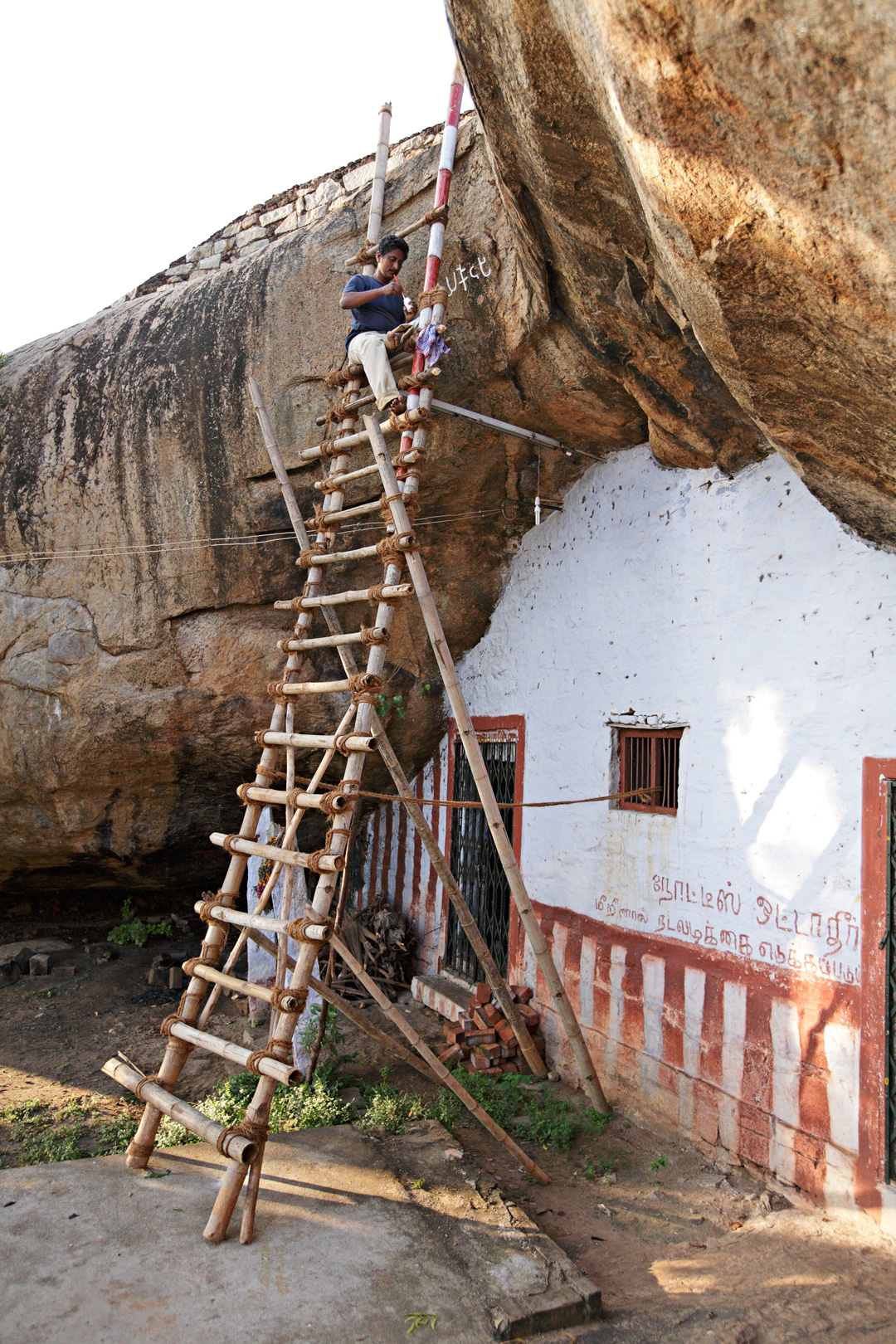 Fig. 7. Varichiyur, a very challenging site with the inscriptions in an advanced state of decay. January, 2009. We sought to document the Tamil-Brāhmī stone inscriptions letter by letter. So, for each inscription, we trace-painted and photo / videographed the inscription one letter at a time. This meant that we could not work with a scaffold, as was done earlier when the inscriptions were traced, or the scaffold would be in the way of the camera. In all locations, we used ladders (Figs. 5 – 7) which could be removed after painting each letter and replaced before painting the next. So if an inscription had 20 letters, let us say, at a height of 20 feet, we would have to go up and down the ladder that many times to trace-paint, and remove the ladder and put back each time. If we made a mistake anywhere, we started all over again. In Pulankurichi, just as we finished trace-painting the mammoth inscription on the rockface (Fig. 3), it began to rain. We simply had to abandon 4 days of work and go back another time to redo the trace-painting and the digitisation. We still had some luck left and it did not rain the second time. We finished the shoot and washed the trace-painting away ourselves as we did after each shoot, working with white poster colour, which is easy to wash off. 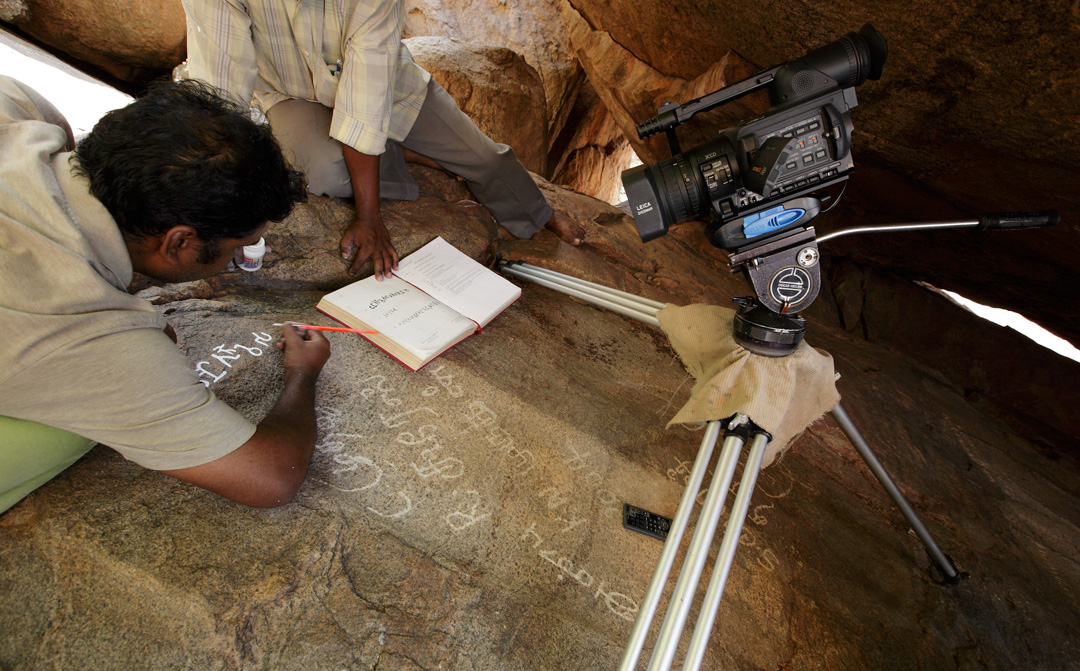 Fig. 8. The camera, locked in the same position, waits for the next letter to get trace-painted and ready, by D. Samson at Aiyarmalai. March, 2009. Note the modern graffiti by vandals on the stone bed. 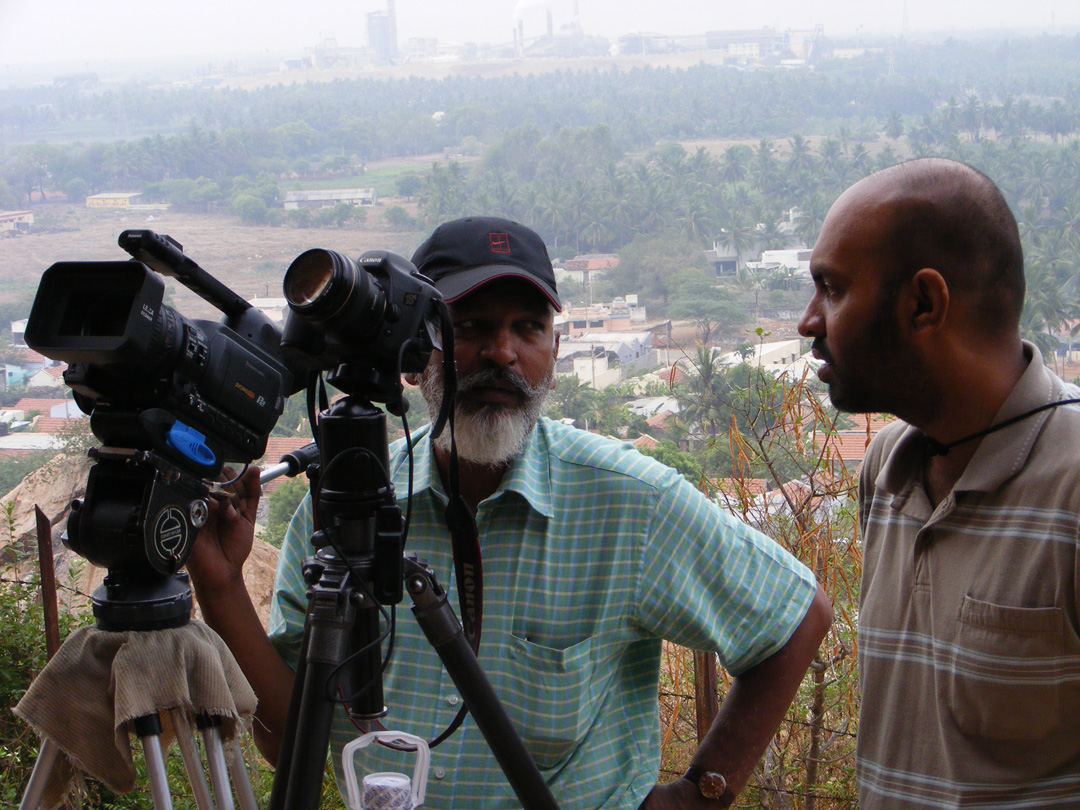 Fig. 9. L to R : Sarangarajan controlling the HD video and Rajiv Kumar handling the still imaging. Pugalur. March, 2009. Throughout the trace-painting process, the still and the video cameras were kept locked in one position, ready to shoot (Figs 8 & 9). In this method, shooting one inscription can take an entire day, from dawn to dusk. Though the camera is locked in one position, the sun and clouds are not and so the light and shade and tone and depth vary from letter to letter. Often the wind fluttered the large cloth canopies our crew had to hold across from precipice to precipice, making it really difficult to ensure evenness of light. In the end, the 20, or whatever the number of, exposures were put together as a composite to see the full inscription. This way, you, the reader, see the letters on the bare rock and also as traced. On video, the viewer will be able to see the letters appear one by one. It must be added that there were also several instances when an inscription in its entirety could not be composed in one frame. We used pan-shoot-and-stitch method to capture such inscriptions. We planned and divided the inscription into three or four parts, exposed them separately and then combined them into a single composite. We rid the composite of excessive contrast. There is no manipulation of the image otherwise. It is a light non-intrusive edit that historical records demand. The Editing Process for Various Media and its TechnicalitiesAfter the first preview of the full Corpus, Iravatham Mahadevan and I spent more than a month in front of the computer, viewing and correcting the inscriptions at often 8000% magnification. Corrections were always marked on hard copy, on good quality trace paper over high resolution printouts. When in doubt, any letters requiring correction were re-checked in situ. The rare mistakes, contemporary scribal errors, made in trace-painting the inscriptions were digitally corrected first on the still photographs. On video, the corrections were motion-matched, and contrast neutralised. Video and image were both subtitled, initially in MS Arial Unicode and ultimately in Linux Libertine, and downsampled for the web. The main body of all textual content for the project was inherited from ETE 2003, typeset in Times Alex Indian, a standard font in print production for Indian archaeology. The files were in Page Maker, supplied by Iravatham Mahadevan, typeset by Cre-A. From Page Maker to InDesign was many a slip. We had to manually re-correlate all footnotes. Font weights did not transform. There were no font weights to transform. Page Maker handled Word supplied weights, but InDesign did not handle Page Maker's. I had to do a minor fix to get the different weights, resupply the font set to InDesign and then manually fix document font weights over seven or eight iterations of proof checking by Iravatham Mahadevan. Even so, 'we cannot be sure' if we have indeed fixed all that was lost in transformation. There was another option, that we could work with the MS Word files, which Iravatham Mahadevan had, instead of the Page Maker files. But when we started out recomposing the book, it looked easier, deceptively so, to stay with the DTP look in the revision process. Clearly, it was a wrong choice, for the so-called revision turned out to be an extensive expansion. But we could not take a u-turn halfway and worked the full-length through in InDesign. Besides the choice of application, we went wrong on the font too. Times Alex Indian has all the diacritics needed for rendering Tamil and Sanskrit in Roman. The font behaves by and large okay, but is clumsy of certain glyphs and kerning. Beyond print, the content had to be transformed for use in video and browser, Times Alex Indian being non-Unicode compliant. Our Hobson's choice became MS Arial Unicode. Probably a bit harsh that, for MS Arial Unicode chose itself for its Tamil support and full diacritic set. We do not see boxes or gut-spilling HTML, but that took a lot of 'find and replace'. In retrospect, we should perhaps have re-encoded Times Alex Indian for Unicode right at the beginning of the project. While lamenting it, I discovered that moving to an open-source font like Linux Libertine is a better option. We converted in the end. However, there is no support for Tamil in Linux Libertine and so all Tamil content is in Vaanavil Bharathi. I plan to address this gap before the HTML and video release of this content, by supplying Tamil glyphs to Linux Libertine, so we have a bilingual Tamil-English font that modern scholarship so badly needs. The Outcome of the SurveyThe Survey was scoped for high-resolution still imaging and HD video of the inscriptions and the associated historical and geographical information. The thinking was, the still photography in high resolution would document the inscription and the HD Video, the surrounding information. The approach was that the documentation would not lead to a documentary but to a fully curated archive of the inscriptions and their historical and geographical contexts. What you see in this book is a part of this archive, structured and indexed around the textual interpretations of Iravatham Mahadevan. It has always been one of the principal aims of this Project to share the content online and through other electronic forms as facilitated by the evolving technological landscape. While some of the objectives of this project have been realised, and some others likely to be, perhaps to the satisfaction of all the stakeholders, not everything has been done that can be. To begin with, digital photography is not without its limitations. Compared to estampage and tracing, photography is a non-contact form of documentation and produces its own distortion. However, this is by far the most easily shareable form of documentation and will continue to be so in the foreseeable future. The main body of all textual content for the project was inherited from ETE 2003, typeset in Times Alex Indian, a standard font in print production for Indian archaeology. The files were in Page Maker, supplied by Iravatham Mahadevan, typeset by Cre-A. From Page Maker to InDesign was many a slip. We had to manually re-correlate all footnotes. Font weights did not transform. There were no font weights to transform. Page Maker handled Word supplied weights, but InDesign did not handle Page Maker's. I had to do a minor fix to get the different weights, resupply the font set to InDesign and then manually fix document font weights over seven or eight iterations of proof checking by Iravatham Mahadevan. Even so, 'we cannot be sure' if we have indeed fixed all that was lost in transformation. There was another option, that we could work with the MS Word files, which Iravatham Mahadevan had, instead of the Page Maker files. But when we started out recomposing the book, it looked easier, deceptively so, to stay with the DTP look in the revision process. Clearly, it was a wrong choice, for the so-called revision turned out to be an extensive expansion. But we could not take a u-turn halfway and worked the full-length through in InDesign. 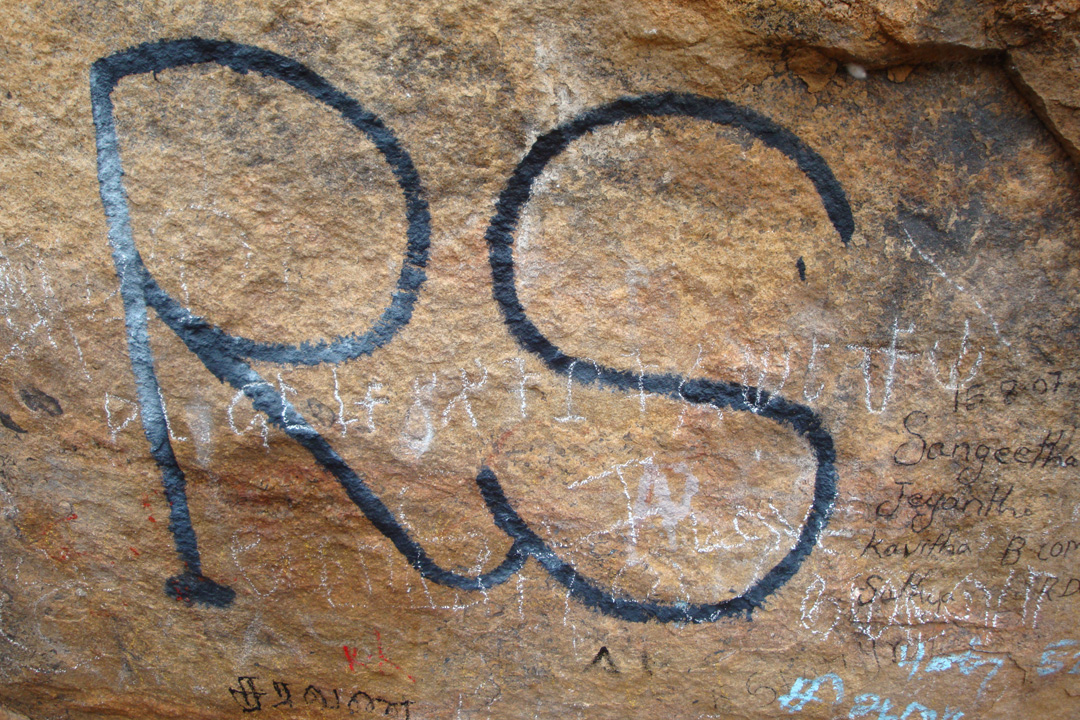 Fig. 10. One of the inscriptions at Tirumalai vandalised by and buried under spray-painting and graffiti. Serious threat of Destruction of the InscriptionsThe priceless civilisational heritage that these inscriptions are, they deserve more attention. There is not a single Tamil-Brāhmī site that does not face the threat of vandalism (Fig. 10) or extinction from mindless granite quarrying (Fig. 5). The Government has to show the political will to halt the destruction. Every site is hugely vandalised by quarry workers, tourists and the ignorant public. Awareness has to be built to stop these and it is hoped that the outcome of the Survey will contribute to spreading the same. Media has been paying occasional, but not impactful, attention to the need for protection and conservation. A creative approach is needed, that looks beyond barbed-wire fencing and tourism promotion. Future ProspectsAs for documentation, before we could finish the Survey as per the scope agreed to in 2007, a spate of new technologies have emerged. Now there is 4K video, video that is four times as high in resolution as what we have documented. There are 80 megapixel cameras. There are 3D filming cameras. And there is, has always been, film, though expensive and inconvenient, still the most reliable record, a physical one. There are other non-camera based forms of documentation. For instance, the inscriptions can be latex-moulded to produce exhibits that duplicate the physical feel. Depth and damage analysis can be undertaken, to mention a few more. Special ThanksThis exercise will not be complete without placing on record my sincere gratitude to everyone who helped this project, and without exception, selflessly. I must make a special mention of my indebtedness to Mariam Ram, Managing Director of TNQ Books and Journals Private Limited, who opened out her organisation and put its people, including myself on the job, giving space and resources unconditionally at critical junctures for this project to reach its completion. My thanks also to Suki Venkatesan, Chief Technology Officer, TNQ Books and Journals, for helping me figure out the technical scope of the project and to Ramakrishnan of Cre-A :, the publisher of ETE 2003 who shared his expertise and fine judgment to make sure that I approached it right, right through the length of the project. 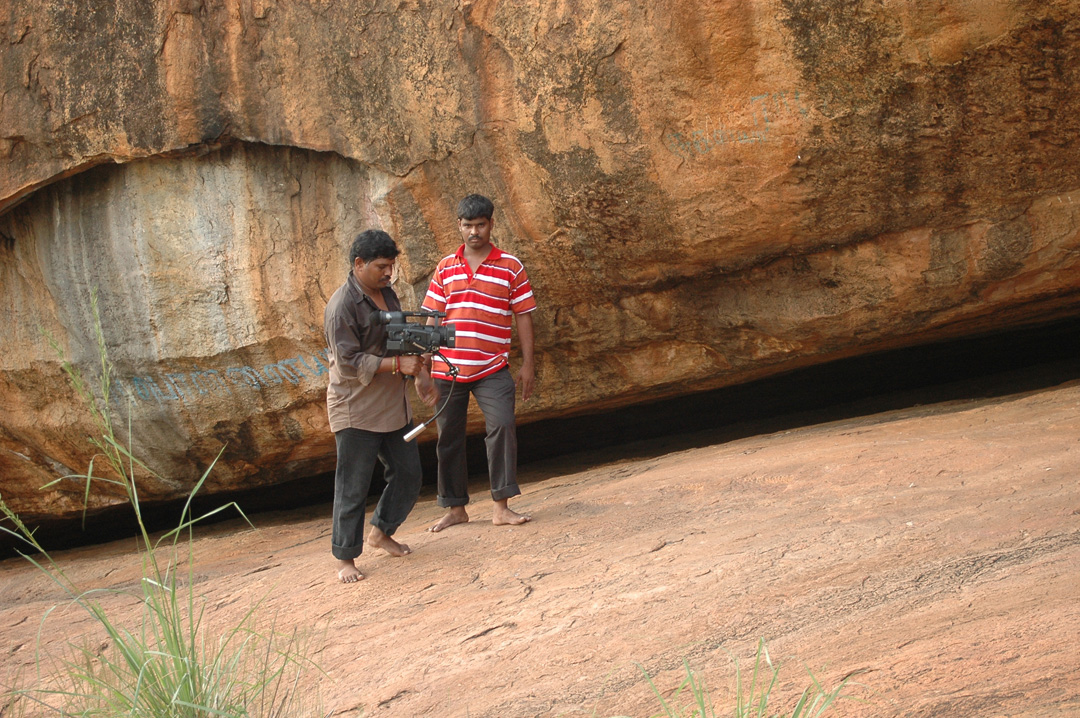 Fig. 11. Thanigaimani shooting walkthrough at Mettuppatti. November, 2009. A Learning ExperienceThe Survey was a great learning experience for all of us. It was a job to be done, the money was paid for it, and we enjoyed doing the job. So much so that between the first trip to Mamandur in December 2007 and the last field assignment to Edakal in December 2012, we went back to each of the sites many times. For reconnaissance first. To shoot. To verify if what we shot was indeed correct. To capture the surroundings, the geographical information, and the historical details from the times before and after Brāhmī. To separately shoot walkthroughs to many of the caves (Fig. 11). And then to capture the ambience of these caves in the rainy months so as to see and show how the dripledge worked. We stayed at nights in many caves. We camped with the bats and owls and snakes and monitor lizards. We drank lemongrass tea in the mornings. We experienced the caves and the waterbodies at dawn and dusk. In between, we learned to haltingly read the inscriptions, to tell them apart from graffiti and other incisions. We learned Tamil as Tamil was learned over 2000 years ago. We still go back to the caves, even though each time we go we see new signs of degradation, and look at every hill longingly in the hope that we may discover another inscription somewhere, some day. |